Almost nobody in a hospital deteriorates without warning. The observations are nearly always there, written down, in the file. What is usually missing is the moment where somebody puts them together and realises that this patient is worse than they were four hours ago.
That is the gap early warning scores exist to close, and it is a gap software is unusually well suited to filling — because the work involved is arithmetic that happens at exactly the moment a nurse has least time to do it.
What NEWS is
The National Early Warning Score takes six observations that are already being recorded on every patient and turns them into one number. It was developed by the Royal College of Physicians, and its strength is not sophistication — it is that it is simple enough to be used the same way by a first-week nurse, a visiting consultant and a night duty doctor.
The six parameters
- Respiratory rate — the most sensitive of the six, and the one most often estimated rather than counted
- Oxygen saturation, and separately whether the patient is on supplemental oxygen
- Systolic blood pressure
- Pulse rate
- Level of consciousness
- Temperature
Each is scored 0 to 3 depending on which band it falls into, and the scores are added. A completely normal set of observations scores 0.
0–4
Low — ward-level monitoring
5–6
Medium — urgent review
7+
High — emergency response
One parameter scoring 3 matters on its own
Why it fails on paper
Hospitals that adopt NEWS on paper charts usually find compliance is good for a month and poor after six. This is not carelessness. Adding six banded scores by hand, correctly, is a two-minute job at the end of a round where a nurse has twelve other patients and a drug trolley waiting.
So the score gets written in later, or estimated, or skipped on the quiet patients — who are precisely the patients it exists to catch. A deterioration score that is only calculated on patients somebody is already worried about has no value at all.
What software changes
- It is never skipped. The score is computed from the observations as they are entered. There is no separate step to forget.
- It is never wrong. Banding errors and addition slips disappear.
- It becomes a list, not a number. This is the real gain. A score on a chart has to be found. A worklist of everyone currently scoring high, worst first, comes to you.
- The trend is visible. A patient who has gone from 2 to 5 over three sets of observations is a different problem from one who has been at 5 all day.
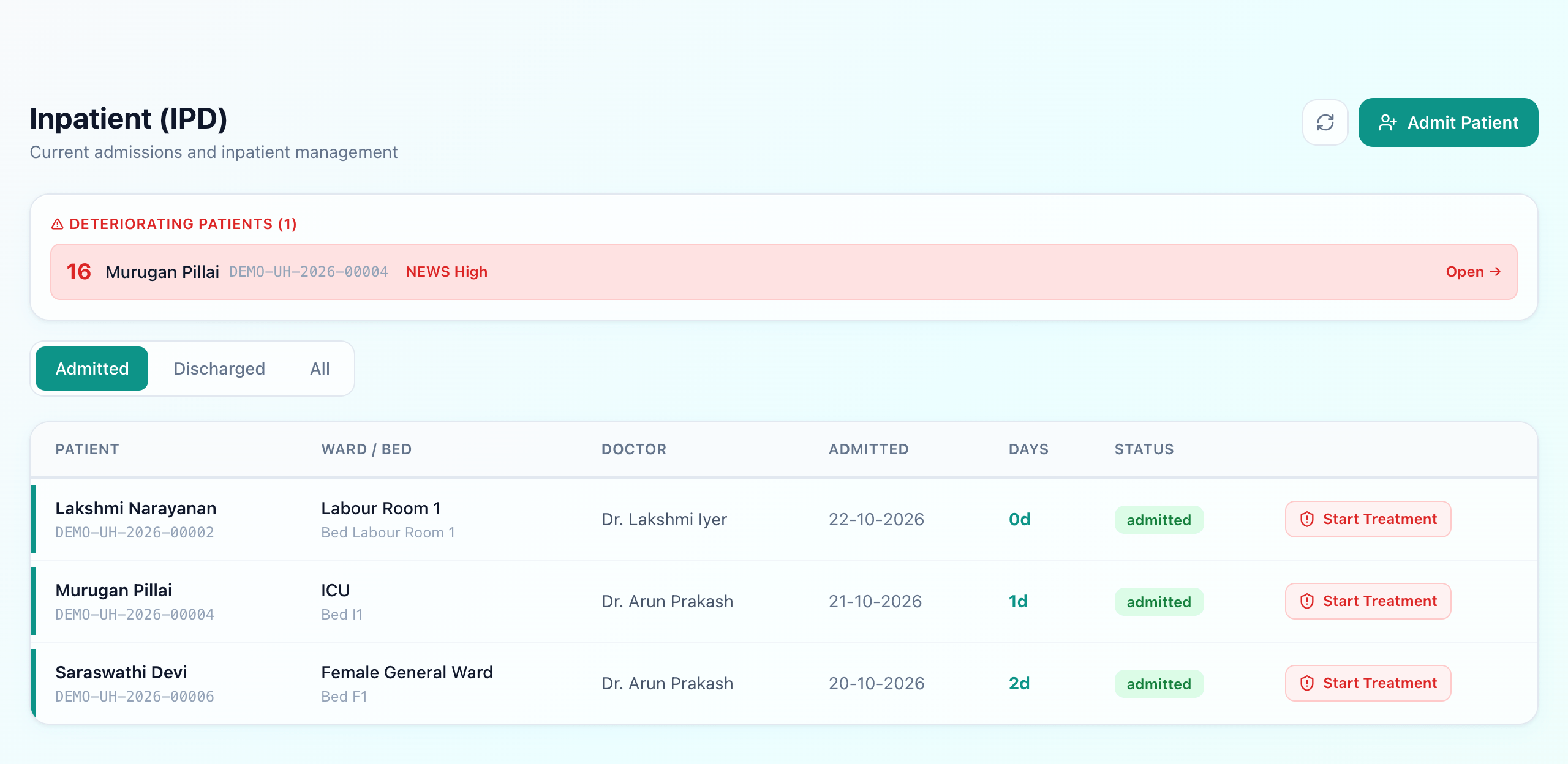
The design detail that decides whether it works
Fitting it to an Indian hospital
Two practical cautions, both learned the hard way by hospitals that adopted scoring systems wholesale.
The escalation policy is the hard part, not the score.A number is only useful if it is attached to an agreed answer to “and then who is called?” In a hospital with one duty doctor overnight, an escalation policy that assumes a rapid response team is theatre. Write the policy you can actually staff, then set the software to match it.
Respiratory rate has to be counted.NEWS leans heavily on it, and it is the observation most often entered as “18” because that is what gets written when nobody counted. A scoring system built on an invented number produces confident nonsense. This is a training problem, not a software one, but it will decide whether your scores mean anything.
Beyond the score: what else belongs on a critical care record
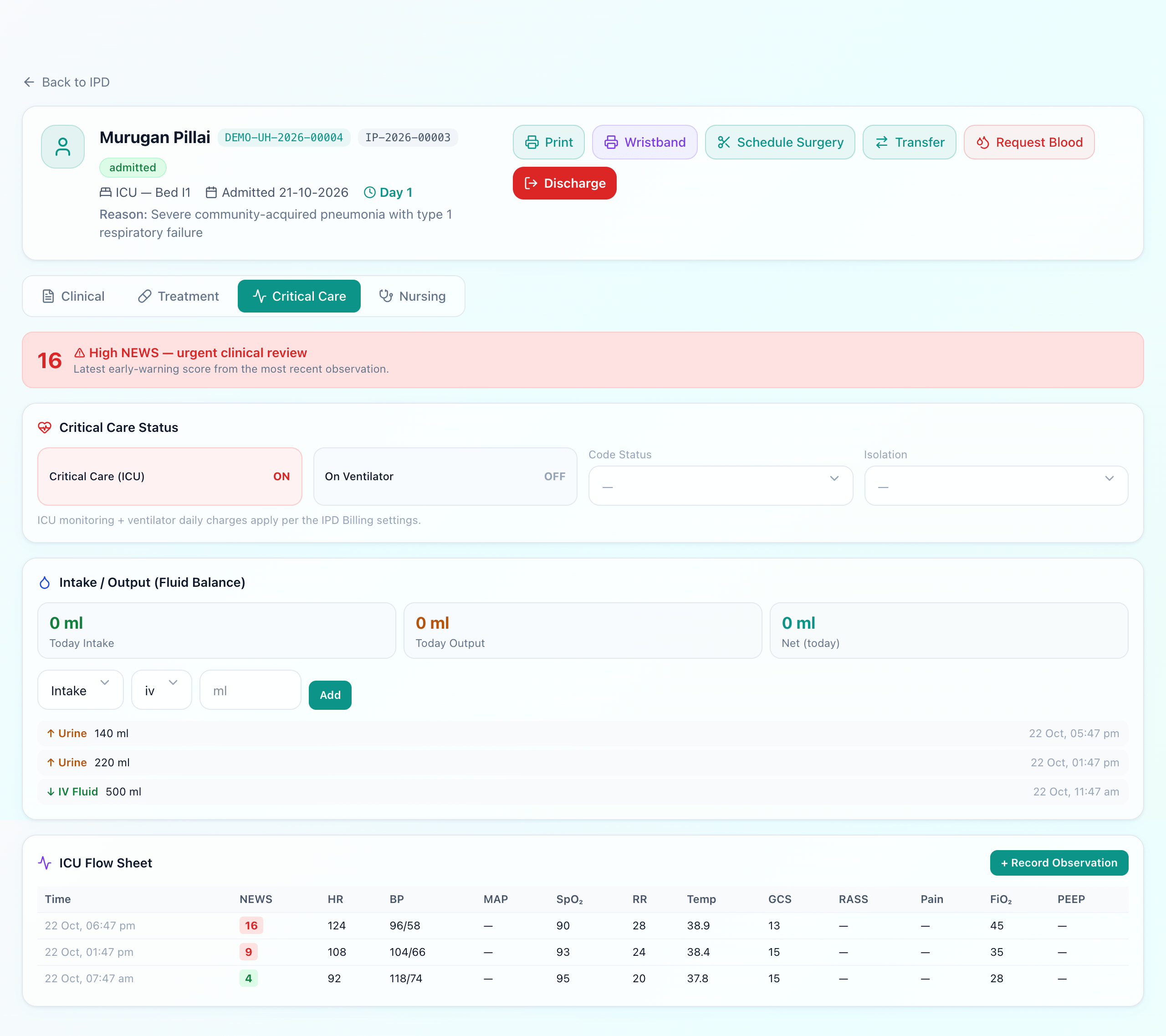
A score is one line of a much longer picture, and it is worth checking that whatever system you use holds the rest of it on the same record rather than on separate charts.
- Fluid balance. Intake and output read alongside the observations, not from a different clipboard.
- Oxygen requirement.FiO₂ captured with the observations, so the score is read in the context of how much support the patient is already on.
- Who is actually looking after this patient. An ICU patient usually has several doctors. If the record only names the admitting one, the chart is lying about who is involved.
How Uyirly does it
NEWS is computed on every set of observations as they are entered for a critical-care admission — nobody adds it up and nobody can skip it. Patients whose latest score is elevated appear on a deterioration worklist, worst first, which stays populated rather than being a notification somebody can dismiss. Fluid balance and FiO₂ sit on the same admission record, and a care team of several doctors can be attached to one patient with their consults and visits tracked.
Detail on the ICU and critical care page. How the admission itself is run is covered in the IPD admission and bed management guide, and what it costs the patient in IPD billing.