IPD billing means billing for the In-Patient Department — a patient admitted to a bed rather than seen and sent home. It is a different problem from OPD billing, where one visit produces one charge. An inpatient stay runs for days, collects charges from every department it touches, and ends in a single bill the family actually has to pay.
This guide shows how that bill is built — where each line comes from, what accrues by itself, and why discharge should be fast rather than an afternoon of reconciliation.
Where the lines come from
One stay, many sources
Bed
Daily room rent
Nursing
Per shift, per day
Pharmacy
Issued to the ward
Lab & imaging
As ordered
Theatre
Procedure + consumables
Each of these is generated by a different department at a different moment, and none of them should need re-entering into a billing screen. The lab does not tell the cashier what to charge; ordering the test is what creates the charge.
What accrues by itself
Bed rent and nursing are the two that must be automatic, because they are the two that recur. Room rent is charged once a day at the room type's rate; nursing is charged per shift per day, so a day with a morning and a night shift produces two lines. An ICU stay adds monitoring, and a ventilator adds its own charge on top.
These are raised as a separate small bill per source per day rather than appended to one growing invoice — which sounds like a detail until a rate changes mid-stay, or a patient moves from a general ward to ICU on day three and the two days before have to keep their old price.
The running total, before discharge
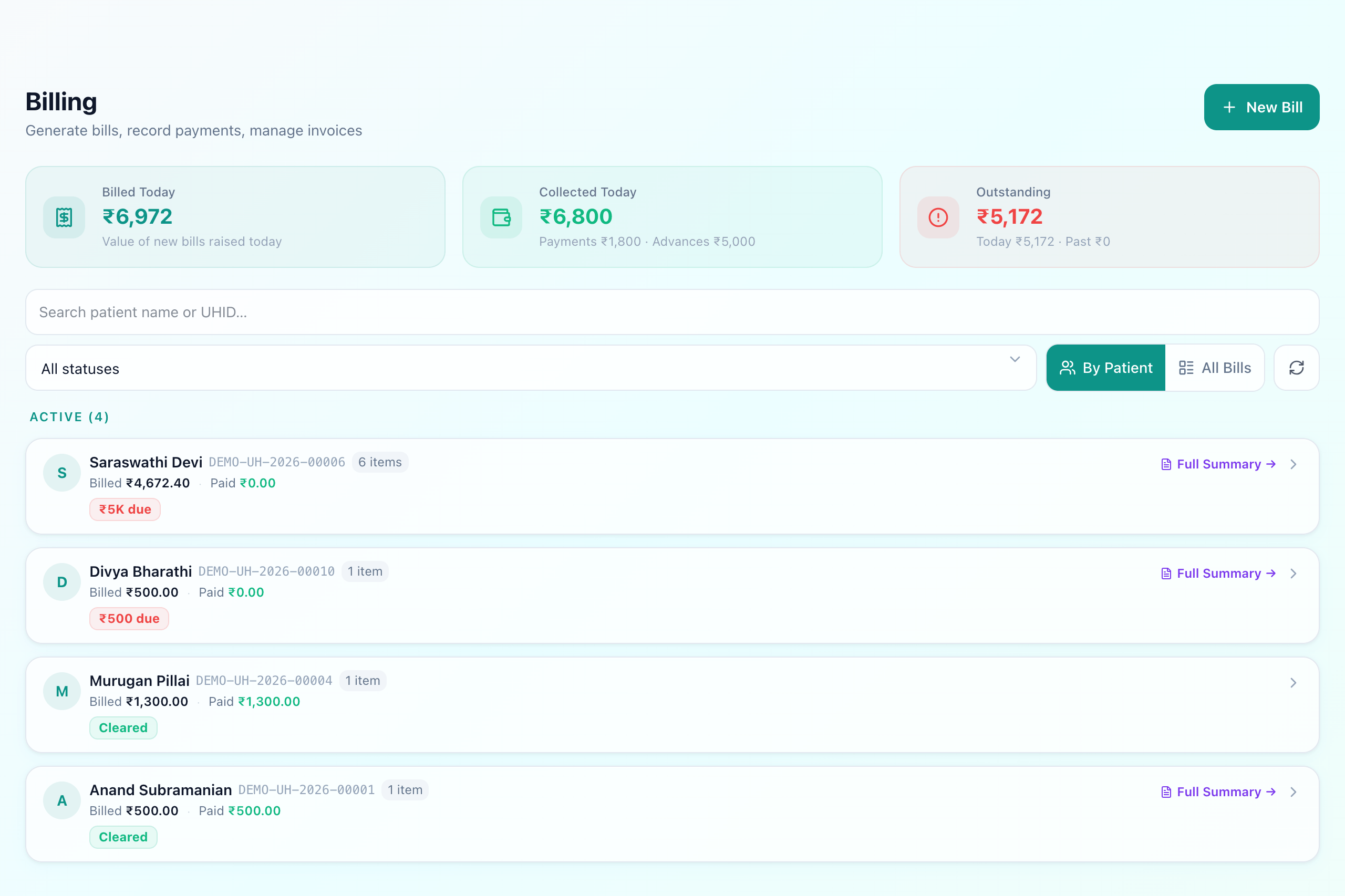
The important word is grouped. A stay generates many small bills, and a screen that lists them as separate rows makes the one question anybody asks — what does this patient owe?— into arithmetic. Grouping by patient answers it directly, and the day's totals across the top (billed, collected, outstanding) answer the hospital's version of the same question.
The combined bill
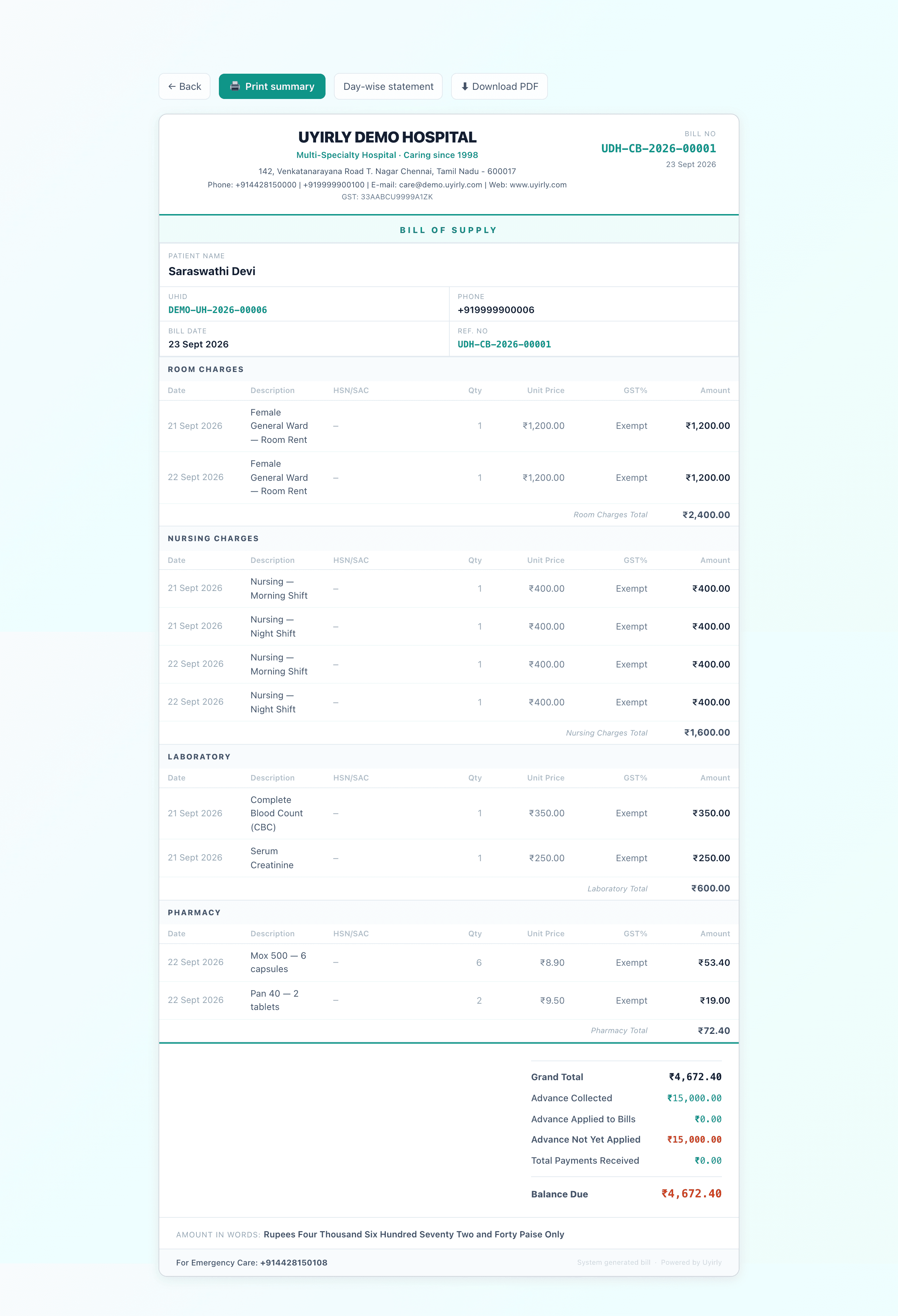
This is what the family is handed. It carries the hospital's letterhead and GST number, the patient and UHID, and then the stay itself grouped into sections — room charges, nursing, pharmacy, lab — each line dated, so a question about any single day has an answer on the page.
Exempt is not the same as zero
Advances, and why discharge is fast
An advance taken at admission is held against the admission, not against a particular bill. That is the right model — the money is the patient's deposit, not a payment for anything in particular yet — but it has a consequence worth understanding: an advance reduces the balance due only once it is applied to a bill, which a cashier does. It does not silently net itself off as charges accrue.
So the bill states all three figures: what was collected, how much of it has been applied, and how much is still sitting unapplied. At discharge the cashier applies the advance and takes the difference — the deposit is never lost track of, and nobody has to remember that a patient paid ₹15,000 three days ago.
If an advance exceeds the final bill, the excess is refunded as its own recorded transaction rather than quietly netted off, so the cash book still balances. For how a refund is issued against a bill that has already been paid, see refunds and credit notes.
Cashless patients
For an insured patient the hospital is not waiting for the family to pay — it is waiting for the insurer. What unlocks discharge is the pre-authorisation approval, which is a different thing from the claim being settled: approval says the insurer will cover a stated amount, settlement is the money arriving weeks later. Discharge should be gated on the first, not the second. The insurance and TPA guide covers the four stages.
Why discharge is where bad billing shows
In a hospital where charges are entered at the end, discharge is an afternoon: someone walks the file to pharmacy, then lab, then the ward, assembling what happened. Two things follow. The bed stays occupied while the family waits, and whatever is missed is never billed — which is why under-billing, not over-billing, is the usual leak.
Where charges post as they happen, discharge is a review: read the bill that already exists, apply the advance, take the balance, print. Everything that made that possible happened days earlier.
What Uyirly does
- Room rent and nursing charges raised automatically each day of the stay, per shift for nursing.
- ICU monitoring and ventilator charges added while those apply.
- Pharmacy, lab, radiology and theatre charges posting from those departments without re-entry.
- Bills grouped by patient, so a stay reads as one balance rather than a pile of invoices.
- Advances held against the admission and applied as charges accumulate; excess refunded as its own transaction.
- An itemised combined bill on the hospital's letterhead, with a day-wise statement and a PDF.
- Cashless discharge unlocked by pre-authorisation approval rather than final settlement.
Getting started
IPD billing is part of Uyirly's hospital management software, and shares one patient record with the ward, pharmacy and lab that generate its lines. See IPD admission and bed management for the stay itself, or start a 30-day free trial.