An itemized hospital bill is both a compliance requirement and, often, the last impression a patient has of their stay. This guide shows what a well-structured hospital bill format looks like — a worked OPD bill format for a single visit and an IPD bill formatfor a multi-day admission — and the fields every hospital bill must include.
What every hospital bill needs
- Hospital name, address and registration details.
- Patient name and a unique identifier (UHID).
- Bill number and date.
- An itemized list of charges by department/service — not a single lump amount.
- Subtotal, applicable tax, discounts, and the final payable amount.
- Payment method and amount paid, with any balance due clearly shown.
OPD bill format — sample
An outpatient (OPD) bill is the simplest case: one visit, usually a consultation plus perhaps a same-day test and some medicine. Here is a sample OPD bill in a clean itemized format:
Sample OPD bill — single visit
Consultation — General Physician
Blood test — CBC
Pharmacy — Prescribed medicines
IPD bill format — sample
An inpatient (IPD) bill spans the whole stay and combines every department that touched the patient — bed rent per day, nursing per shift, consultations, lab, pharmacy and any procedure. Here is a sample IPD bill for a 3-day general-ward admission, itemized so each component is visible:
Sample IPD bill — 3-day general ward stay
Bed rent — General Ward
3 days × ₹1,500
Nursing — Morning & Night shifts
3 days × 2 shifts × ₹150
Admission fee
Consultation — Doctor rounds
3 days × ₹300
Laboratory — CBC, LFT
Pharmacy — Ward medication
An advance paid at admission is held against the stay and set against this total when the cashier applies it — a ₹5,000 advance here leaves ₹3,890 to collect at discharge. A bill should state all three numbers, not just the balance, so the family can see where their deposit went.
The same bill, as software produces it
The samples above are the shape. This is a real one, printed from a two-day admission:
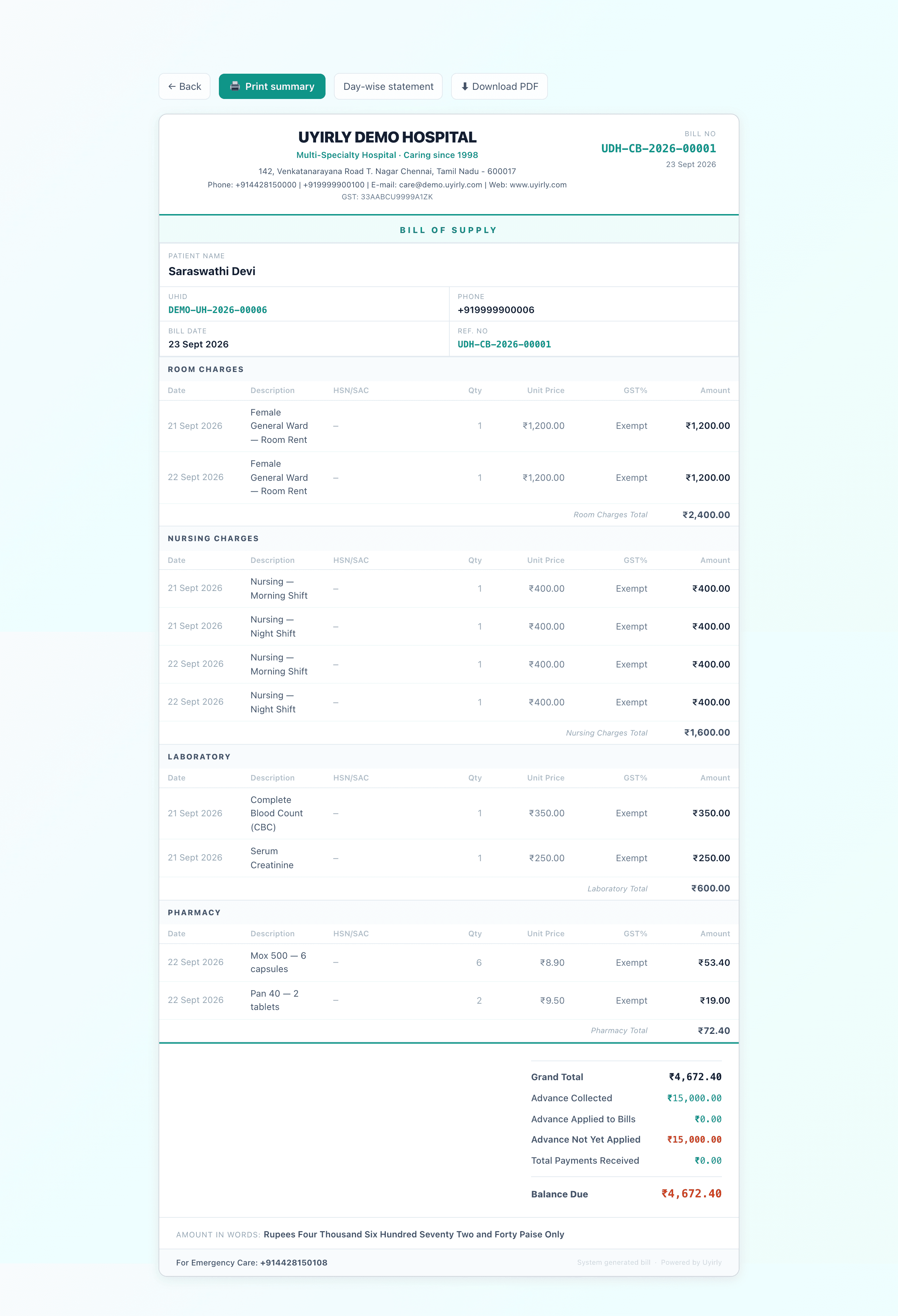
Three things in it are worth copying into whatever format you use. Each line is dated, so a question about a particular day has an answer on the page. Each section carries its own subtotal, so “how much was the pharmacy” does not require adding up rows. And the GST column says Exemptrather than being left blank — a blank reads as an omission, and the patient cannot tell the difference between exempt and forgotten.
For the full department-by-department breakdown of how an IPD bill accumulates day by day, see our IPD billing explained guide.
Why itemization matters
A single lump-sum bill invites disputes, since the patient has no way to see what they're actually paying for. An itemized bill — by department, by day where relevant — builds trust and makes it much faster to resolve any billing question at the front desk. It also matters for tax treatment, since some charges (like room rent above a threshold) are taxed differently from others — see our GST rules for hospital billing. Getting a clean, itemized bill out at discharge is one of the clearest signs a hospital's management software is doing its job.
How Uyirly produces the bill
In Uyirlyyou do not assemble the bill — it builds itself. For OPD, the consultation, tests and pharmacy items land on one receipt. For IPD, bed and nursing charges accrue daily and every test, medicine and procedure posts to the running bill, so the itemised bill is ready the moment the patient is discharged, with nothing to total at the counter.
- One itemised bill across consultation, room, nursing, lab, pharmacy and procedures.
- Every line dated, every section subtotalled.
- HSN/SAC and GST per line, with CGST, SGST and IGST summarised — or marked exempt where healthcare is.
- Headed Tax Invoice or Bill of Supply according to whether any tax actually applies.
- Advance collected, advance applied and advance still unapplied stated separately, beside the balance due.
- Printable, or downloadable as a PDF for the patient or the insurer.
Getting started
Billing is part of Uyirly's hospital management software. See IPD billing explained, or start a 30-day free trial with no credit card.