Before a patient is admitted for a planned surgery or treatment, the very first thing the family wants to know is simple: how much will this cost?Answering that clearly, in writing, is one of the highest-trust moments in the whole hospital relationship. Answer it well and the family feels looked after and can arrange funds or insurance calmly; answer it vaguely — or not at all — and you invite anxiety now and a billing dispute at discharge.
A hospital cost estimate (or treatment quotation) is how you answer it. This guide explains what a good estimate contains, how it differs from a bill, and how a modern hospital system lets your front desk produce a professional quotation in under a minute.
What a cost estimate is — and isn’t
An estimate is an itemised, approximate cost of planned treatment, given before it happens. It is explicitly nota bill: no money is due, no charges are captured, and the final amount will differ based on the patient’s actual condition, length of stay, and what is really used. The skill is being specific enough to be useful while making the “approximate” nature unmistakable.
An estimate must never read like a bill
What goes into a treatment estimate
A credible estimate mirrors the shape of the eventual bill, head by head:
Building up a treatment estimate
Room / bed
Daily rate × expected days
Surgery / package
Procedure tariff
Consultation
Surgeon / physician fees
Investigations
Expected lab & scans
Pharmacy & consumables
Estimated
Estimated total
+ validity & disclaimer
A worked example for a planned procedure with a 3-night stay might look like this:
Sample cost estimate — planned surgery, 3 nights
Room rent — Semi-private
₹4,000 × 3 nights
Surgery package (procedure)
Surgeon & anaesthetist fees
Investigations (lab + radiology)
expected
Pharmacy & consumables
estimated
The patient now knows to arrange roughly ₹86,000 — and if they have insurance, this is the figure the TPA needs for cashless pre-authorization.
Estimate vs bill: keep them separate, share the tariffs
The estimate and the final bill are different documents with different jobs, but they should be built from the same underlying prices. If your room rates, procedure/package tariffs and consultation fees are defined once, the estimate is assembled from those numbers, and the eventual IPD billuses the same rates as charges actually accrue. That consistency is what makes the final bill land close to the estimate — the single biggest driver of billing trust.
Package estimates vs itemised estimates
There are two ways to quote a planned treatment, and good hospitals use both depending on the case. A package estimategives a single all-inclusive figure for a defined procedure — say “cataract surgery, ₹25,000, includes surgeon fee, OT, lens and two follow-ups.” It is simple for the patient, competitive to advertise, and easy to compare, but it only works when the scope is genuinely predictable. An itemised estimatebreaks the cost into heads — room, surgery, fees, investigations, pharmacy — and is the right choice for variable or complex cases where a single number would be misleading.
The two are not mutually exclusive: a mature estimate often shows a package line for the fixed core of the treatment and itemised lines for the parts that genuinely vary (a longer stay, extra investigations, a higher-category room). What matters is that the patient can see what is fixed and what could move, so there are no surprises later. Trying to force every treatment into a flat package leads to either the hospital losing money on the hard cases or padding the price for everyone; trying to itemise a routine, predictable procedure just makes the quote harder to read. Match the format to the predictability of the case.
When the actual bill differs from the estimate
An estimate is a forecast, and forecasts miss — a patient stays an extra two nights, needs an investigation nobody anticipated, or recovers faster and costs less. That is normal and expected. What turns a variance into a dispute is silence: the family hears one number at admission and sees a very different one at discharge with no explanation in between.
The professional way to handle this is to keep the family informed as reality diverges from the estimate, especially for a long or complicated stay. If the running charges are clearly higher than what was quoted — because the clinical course changed — that conversation should happen during the stay, not as a shock at checkout. A running or interim bill that the family can see at any point during an admission is the best antidote: the estimate sets expectations, the running bill keeps them current, and the final bill holds no surprises. This is exactly why estimates and live IPD billing belong together.
Estimates and insurance pre-authorization
For an insured patient, the estimate does double duty: it is also the basis for cashless pre-authorization. Before a planned admission, the hospital submits the expected cost to the patient’s TPA or insurer, who approves a sanctioned amount against which treatment can proceed without the patient paying up front. A clear, itemised estimate makes that submission faster and more credible — the TPA can see exactly what the money is for. If the actual course exceeds the sanctioned amount, an enhancement request is raised mid-stay. The tighter your estimate, the smoother the whole cashless journey; a vague estimate leads to under-sanctioning and awkward top-up conversations later. The full pre-auth and settlement flow is covered in the TPA claims guide.
How Uyirly offers this
Uyirly has a dedicated Cost Estimatesarea (under Billing) built for exactly this moment. A receptionist creates an estimate for a patient — or even a walk-in enquiry with just a name and phone — and assembles it from the hospital’s real tariffs:
Room × days
Auto from ward daily rate
Packages
From your procedure tariffs
Any line
Add lab / scan / pharmacy
< 1 min
To a printable quotation
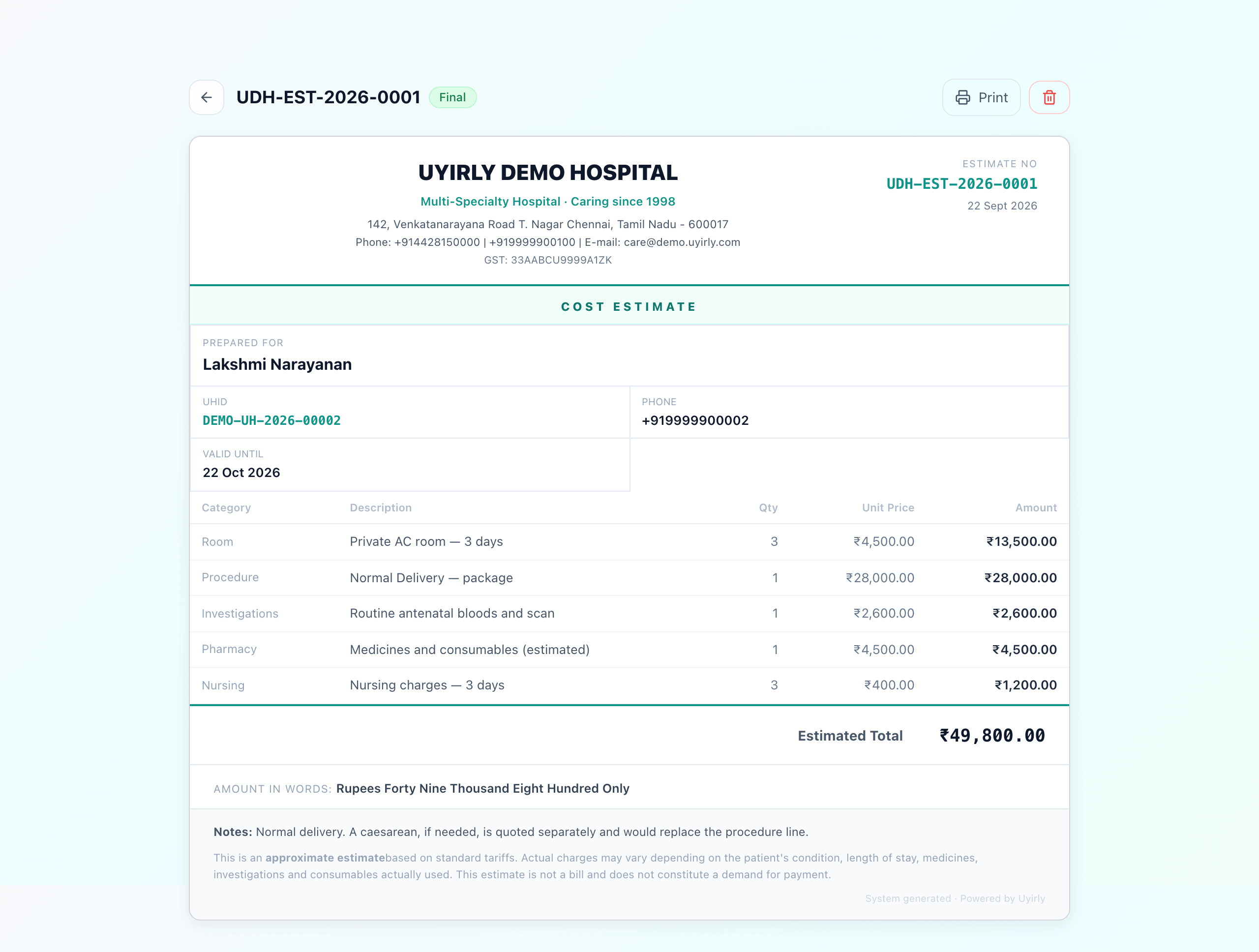
The result prints as a clean, hospital-branded “COST ESTIMATE” document with your logo, a validity date, the itemised heads, the estimated total in words, and the disclaimer built in. It can be printed for the family or kept on file. Crucially, it is not a bill— nothing is charged — and because it’s built from the same tariffs the admission will use, the final bill lands close to what the family was told.
Estimate first, admit with confidence
Where estimates fit
A cost estimate is the front door to the whole billing journey: estimate → admission → charges accrue → combined IPD bill at discharge, with insurance running alongside via TPA pre-authorization and settlement. Getting the estimate right sets the tone for everything that follows — and it costs you nothing but a minute at the front desk.