Emergency is the one department where registration cannot come first. A patient arrives by ambulance, unconscious, with no name and no phone — and the clock that matters started before they reached the door. Software that insists on a complete record before anything can be recorded is software that will be worked around.
Triage decides the order, not arrival
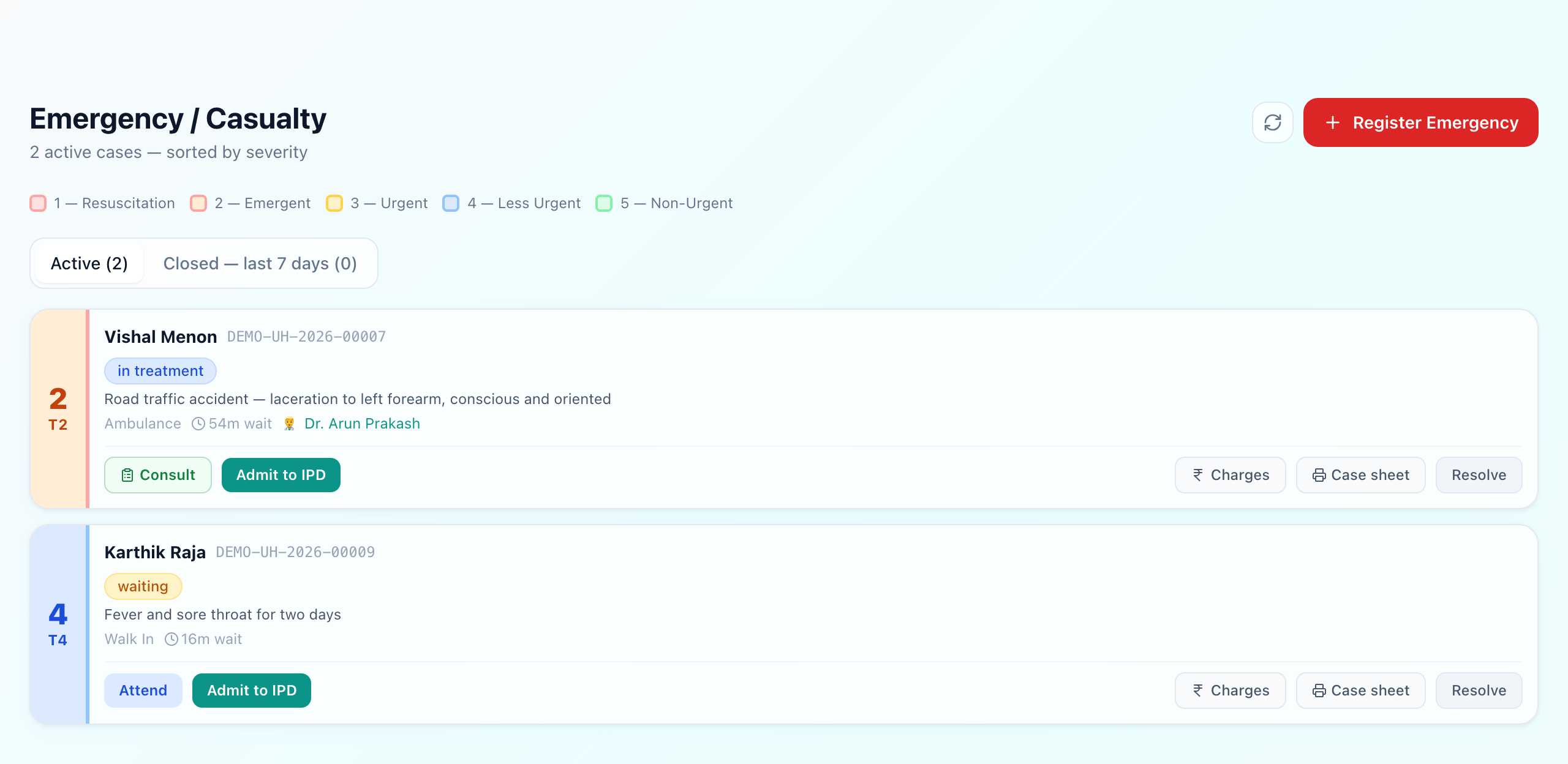
Every case carries a triage level from 1 to 5 — the standard five-point scale, where 1 is resuscitation and 5 is non-urgent. The list is read by severity rather than by arrival time, which is the entire point of triage: the person who walked in twenty minutes ago with chest pain is seen before the person who arrived an hour ago with a sore throat.
Arrival mode is recorded too — walk-in, ambulance or referral — because a patient brought in by ambulance carries different expectations and often a different handover.
The unidentified patient
A case can be registered with what is actually known: an approximate age, an apparent gender, and nothing else. A provisional record is created so treatment can be recorded against someone, and the identity is filled in later when a relative arrives. Insisting on a phone number or an Aadhaar at that moment does not produce better data — it produces a workaround.
Two registrations that should not happen
The system refuses both, and this is worth knowing because both are common under pressure:
- A second emergency case for a patient who already has an active one — the existing case is resolved or continued, not duplicated.
- An emergency case for a patient already admitted as an inpatient — an admitted patient who deteriorates is a ward event, not a new ER arrival.
Duplicate records made in an emergency are the hardest kind to merge later, because the two halves of the story are both real.
Where the case goes
An emergency ends in one of a few ways: treated and sent home, referred elsewhere, or admitted. Admission from the ER carries the record with it — the admission records the emergency case it came from, so the trail from ambulance to bed is intact and the patient is not registered twice.
What Uyirly does
- Registration in seconds, including for a patient nobody can name yet.
- Triage levels 1 to 5, with the list read by severity rather than arrival.
- Arrival mode — walk-in, ambulance or referral — recorded on the case.
- A second active emergency case, or one for an already-admitted patient, refused at the source.
- Admission straight into IPD, recording the emergency case it came from.
- Charges reaching the same patient bill as everything else.
Getting started
Emergency is part of Uyirly's hospital management software, sharing one patient record with the ward, lab and pharmacy that the case will touch. Start a 30-day free trial — no credit card.