Every rupee a hospital collects passes through a front desk or cashier — consultation fees, bill payments, IPD deposits, the occasional refund. If that money is only tracked as individual receipts, nobody can answer two questions that the owner and the auditor care about most: how much did we actually collect today, and does the cash in the drawer match? The answer is a cashier day-book and a disciplined shift-close reconciliation.
This guide explains how hospital cash control works — the day-book, the shift close, and the one accounting subtlety (advances) that trips up most systems — and how to run it without a spreadsheet.
The cashier day-book
A day-book is simply every money movement for a day, in one place. Not a pile of receipts — a single view that groups collections by payment method (cash, card, UPI, bank transfer) and by cashier, so finance can see the shape of the day at a glance and drill into any line.
What flows into the day-book
Bill payments
Cash / card / UPI / bank
Advance deposits
IPD collections
Refunds
Money paid out (−)
Day-book
Grouped by method & cashier
Notice refunds are negative— money leaving the drawer — and the day-book nets them out. The result is a truthful “net collected” figure per method and per cashier.
The one subtlety that breaks most systems: advances
Hospitals take advance deposits, especially for IPD. Here is where naive cash reports go wrong. When a patient pays a ₹50,000 deposit, that is real cash in the drawer today. Later, that deposit is appliedto their bills — but no new money changes hands; it is an internal credit moving from “deposit” to “bill paid.”
Count the deposit once, not twice
This is exactly why a bill’s “paid” amount alone is a poor measure of daily collection — an IPD bill paid from an advance represents money that arrived on a different day. Cash control has to be built on money movements, not on bill status. (For how advances flow through billing, see the IPD billing guide.)
The shift close & cash reconciliation
At the end of a shift, the cashier physically counts the cash drawer and compares it to what theyshouldhave collected in cash. That comparison — and recording it — is the single most important cash control a hospital has.
Closing a shift
Expected cash
System: cash collected − paid out
Count drawer
Physical cash
Variance
Counted − expected
Handover slip
Signed record
The variance(counted minus expected) is the number that matters. Zero is ideal; a small difference is human; a repeated or large gap is a signal to investigate — wrong change, a payment logged under the wrong method, an unrecorded cash refund, or something that needs a harder look. Either way, it is now on the record, tied to a named cashier and a time window.
Multiple cashiers and clean handovers
Most hospitals run more than one collection point — an OPD counter, an IPD/billing desk, sometimes a pharmacy till — and each changes hands across shifts. Cash control only works if it is per cashier, not just per hospital. Each person is accountable for the money they collected during their own window, and the day-book must be able to show “how much did Priya collect on the morning shift, and did her drawer match?” independently of everyone else.
The handover is the risky moment: if one cashier hands a drawer to the next without a recorded count, neither can be held responsible for a later shortfall. A disciplined process closes each shift with a count before the next begins, so responsibility passes cleanly. A printed, signed handover slip — showing who handed over, who received, the expected and counted cash, and the variance — makes that transfer accountable and gives finance a paper trail for every drawer, every shift.
What to do about a variance
A variance is information, not automatically a crime. The response should scale with the size and pattern:
- A few rupees, occasionally— almost always rounding or change-making; note it and move on.
- A payment logged under the wrong method— e.g. a card payment recorded as cash — shows up as a cash shortfall with a matching card excess; correctable and worth a quick process reminder.
- An unrecorded cash refund— money went out of the drawer without a credit note; this is why refunds must always be recorded (see the refunds & credit notes guide).
- A repeated or growing shortfall for one cashier— the real signal; now you have dated, named records to investigate a person or a process, instead of a vague suspicion.
The point of recording variances is not to punish honest mistakes — it is to make patterns visible. A hospital that has never measured its variances has no idea whether it is losing money at the counter; one that measures every shift knows within a day.
The collection reports finance actually needs
Beyond the drawer count, finance and the owner want a small set of numbers the day-book should answer instantly: total collected today and this month; the split by method (how much cash vs card vs UPI vs bank, which matters for banking and for spotting a sudden shift in patient behaviour); collection by cashier; and refunds paid out. Kept in one live view, these turn “how are we doing on collections?” from a week-end spreadsheet exercise into a glance — and they must reconcile with what the billing side says was charged and paid, or one of the two is wrong.
How Uyirly offers this
Uyirly includes a Cash Book(under Billing) that computes all of this live — no spreadsheet, no manual tally.
Day Book
Every movement, by method & cashier
My Shift
Close with live expected cash
Variance
Counted vs expected, recorded
Handover slip
Printable, signed
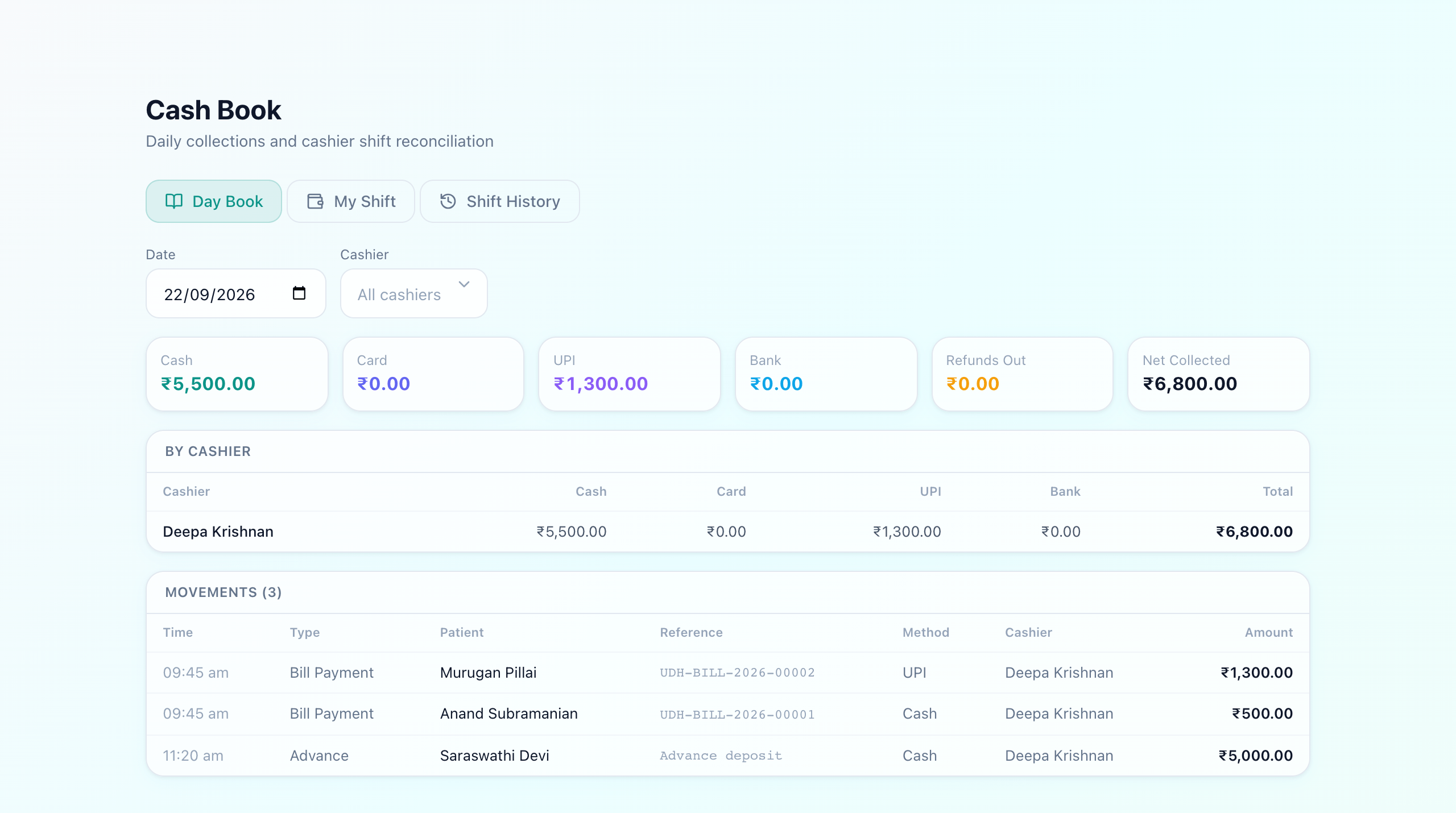
The Day Booktab shows, for any date, summary cards (Cash / Card / UPI / Bank / Refunds / Net), a per-cashier breakdown, and the full list of movements — every bill payment, advance deposit and refund. It counts money the right way: advance deposits are in, advance adjustments are excluded, refunds are netted out.
The My Shift tab shows a cashier their live expected cash since their last close, plus card/UPI/bank totals. They enter the counted cash, see the varianceinstantly, add a note, and close — producing a printable handover slip with signature lines. The History tab keeps every close for audit.
Make shift-close a habit
Why it matters
Cash leakage is quiet and cumulative. A day-book plus shift-close reconciliation makes every rupee traceable to a method, a cashier and a time — deterring leakage, catching honest mistakes early, and giving the owner a daily collection figure they can actually trust. It pairs naturally with IPD billing and clean bill formats to close the loop from charge to collected cash.